Breaking into remote work can feel like trying to enter a crowded room where everyone else already seems to have experience, polished résumés, and a long list of technical skills. Many job advertisements ask for previous experience, familiarity with specific software, or evidence that you have already performed similar work.
But there is an important distinction that can change the way you approach your search: having no professional experience is not the same thing as having no valuable skills.
If you are wondering how to get a remote job with no experience, there is no single shortcut or secret application strategy that guarantees success. Instead, the process involves identifying what you can already do, developing the skills employers actually request, creating evidence of your abilities, presenting yourself clearly, and applying to roles that genuinely match your current level.
You may already have useful experience without realizing it.
A university project can demonstrate research and organization. Volunteer work can reveal communication and teamwork skills. A personal project can show initiative. Freelancing, part-time work, community activities, and even carefully managed responsibilities outside employment can provide evidence of planning, reliability, problem-solving, and follow-through.
The objective is not to make your background look more impressive than it really is. It is to make the value of your existing experience easier for an employer to recognize.
This guide walks through the process step by step—from choosing realistic entry-level remote positions and developing practical skills to building a résumé, creating work samples, finding legitimate opportunities, preparing for interviews, and avoiding common job-search mistakes.
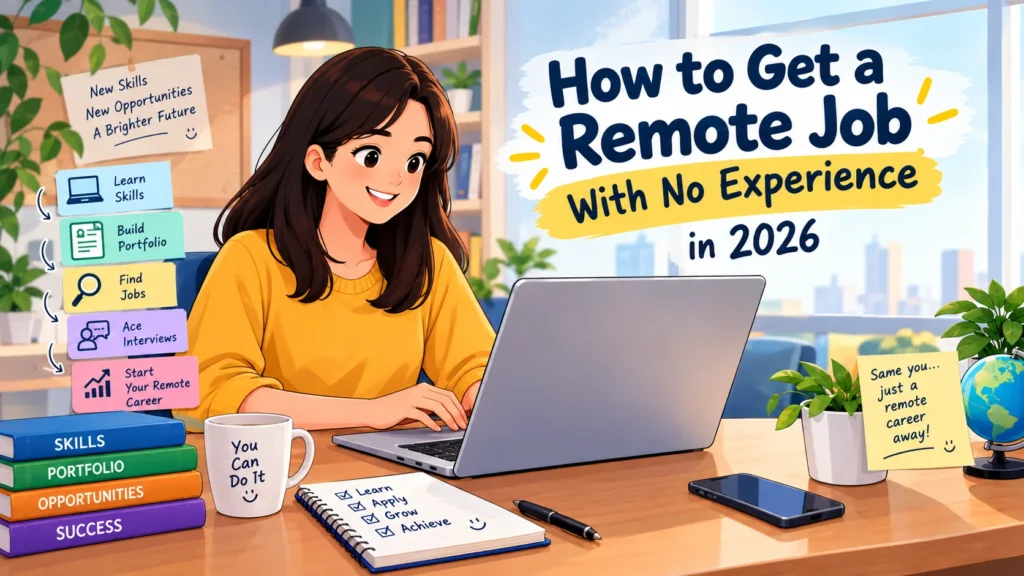
Table of Contents
What Does “Remote Job With No Experience” Really Mean?
A remote job with no experience generally means a position where the employer does not require substantial previous professional experience in the same occupation.
That does not mean the employer expects you to arrive without skills.
Consider an entry-level customer support position. You might not need several years of customer service employment, but you may still be expected to communicate clearly, use a computer comfortably, follow instructions, document information accurately, and respond to problems professionally.
The same principle applies to administrative work. An employer may not require previous office employment, yet the position could involve scheduling appointments, organizing documents, answering emails, updating spreadsheets, and supporting other team members.
The distinction is simple:
No professional experience does not mean no useful skills.
Your task is to uncover the skills you already possess, identify the requirements of the jobs you want, and connect the two honestly.
That shift in perspective matters. Instead of repeatedly asking, “Why would anyone hire me when I have no experience?” you can begin asking a much more productive question:
“What evidence can I provide that I can do this work?”
How to Get a Remote Job With No Experience
A beginner-friendly remote job search becomes much easier to manage when you break it into practical stages.
- Choose realistic entry-level roles.
- Identify your transferable skills.
- Learn the most relevant basic skills.
- Build a small portfolio or work sample when appropriate.
- Create a targeted résumé.
- Improve your professional online presence.
- Search legitimate job sources.
- Customize your applications.
- Prepare for remote interviews.
- Continue learning while you apply.
You do not have to complete every step perfectly before submitting your first application. In fact, waiting until you feel completely “ready” can unnecessarily delay the process.
Learning and applying can happen simultaneously.
As you research job descriptions, you will discover which skills appear repeatedly. Those patterns can then guide what you learn, what you put into your portfolio, and what you emphasize on your résumé.
1. Choose Remote Roles That Match Your Current Skills
One of the most common mistakes beginners make is searching for “any remote job.”
The problem is that remote work is not one occupation. It is a way of working.
Companies hire remote employees across customer service, administration, sales, writing, technical support, research, design, operations, and many other areas. Each role can have a completely different set of expectations.
Rather than searching for everything at once, choose one or two directions that fit your existing abilities and interests.
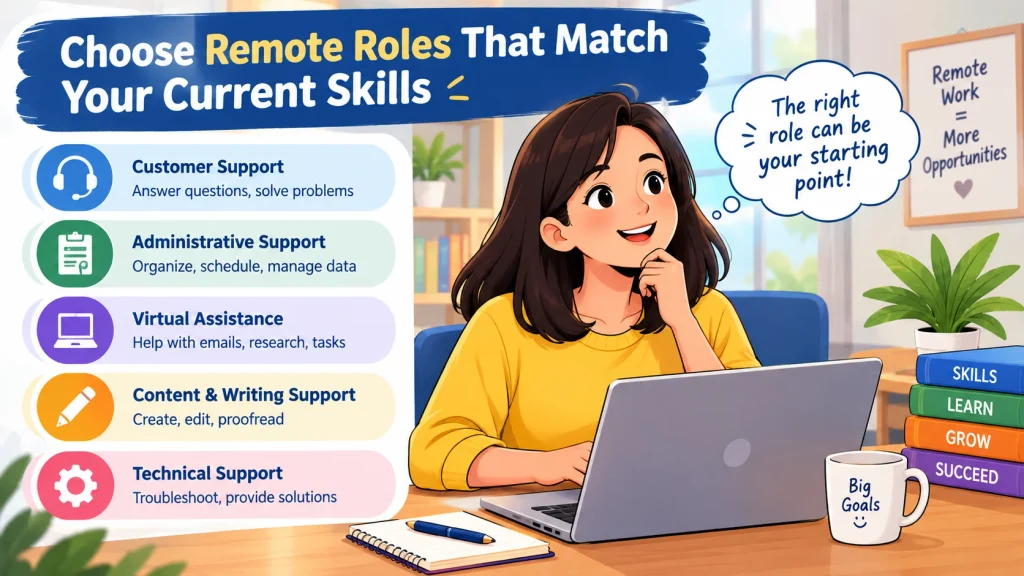
Customer Support
Customer support can be a possible entry point for people with strong communication and problem-solving abilities.
Typical responsibilities may include:
- Answering customer questions
- Responding through email or chat
- Troubleshooting basic issues
- Updating customer records
- Escalating complex problems
- Explaining information clearly
Patience matters. So does organization. And while the work may be performed remotely, the standard for professional communication does not disappear simply because you are working from home.
Administrative Support
Remote administrative positions can involve a wide range of organizational tasks, including:
- Managing calendars
- Organizing files
- Entering information
- Preparing documents
- Responding to routine messages
- Supporting internal teams
Attention to detail is particularly valuable here. A small scheduling error or misplaced document can create unnecessary problems, so employers may care just as much about reliability and accuracy as they do about previous office experience.
Virtual Assistance
Virtual assistants may support individuals, entrepreneurs, or businesses with tasks such as scheduling, online research, email organization, document preparation, and general administrative work.
However, the title virtual assistant covers a surprisingly broad range of responsibilities.
One employer may want someone focused mainly on calendars and email. Another may expect social media support, research, customer communication, or project coordination.
Read the complete job description rather than assuming that every virtual assistant role is interchangeable.
Sales Development and Business Support
Some entry-level sales roles involve contacting potential customers, maintaining records, arranging meetings, conducting basic research, or assisting a sales team.
Communication and persistence can be important.
Before accepting an offer, however, understand exactly how compensation works. Some positions may use salary or hourly pay, while others may involve commission or a combination of compensation structures.
Know what you are agreeing to before you commit.
Content and Writing Support
If writing is one of your strengths, possible opportunities may include:
- Content assistance
- Proofreading
- Research assistance
- Product descriptions
- Basic editorial work
For writing-related positions, a portfolio can be especially useful because an employer can evaluate your work directly instead of relying entirely on your résumé.
A well-written sample can sometimes communicate your ability more effectively than a paragraph claiming that you are a “strong writer.”
Technical Support
Some entry-level technical support positions are designed for candidates with basic technical knowledge who are willing to continue learning.
Depending on the role, relevant knowledge might include:
- Basic troubleshooting
- Operating-system fundamentals
- Networking concepts
- Software familiarity
- Problem diagnosis
Entry-level does not necessarily mean qualification-free. Some technical positions may require certifications or specific technical knowledge, so always compare your current abilities with the actual requirements.
2. Identify the Skills You Already Have
Before spending weeks applying for jobs, stop and take inventory.
What can you already do?
And, more importantly, where did you learn to do it?
Do not limit your answer to previous employment. Useful skills can emerge from many places:
- School or university projects
- Volunteer work
- Community activities
- Personal projects
- Freelancing
- Student organizations
- Online courses
- Previous part-time work
- Family responsibilities
- Small personal projects or businesses
Imagine that you organized a student event. You may have coordinated schedules, communicated with participants, solved unexpected problems, and kept track of multiple responsibilities.
That is evidence of planning and coordination.
Or perhaps you built a spreadsheet to track your monthly expenses. You created categories, entered information, checked calculations, and organized the data.
That demonstrates practical organizational and spreadsheet skills—even though you were not doing it for an employer.
The key is honesty.
Do not inflate a personal project into professional experience. Instead, explain exactly what you did and connect the activity to the skill required by the position.
That approach is both more credible and more useful.
3. Learn the Basic Skills Employers Commonly Request
You do not need to become an expert in every digital tool before you begin applying for remote work.
That would be an inefficient use of your time.
Instead, study the job descriptions for the positions you actually want. Look for patterns. Which skills appear repeatedly?
Depending on the career direction, employers may commonly request familiarity with:
- Word processing
- Spreadsheets
- Professional email
- Video conferencing
- Online calendars
- File management
- Written communication
- Customer-service principles
- Basic research
- Project organization
- Collaboration tools
Suppose you want administrative work. In that case, learning the fundamentals of spreadsheets, documents, calendars, file organization, and professional email may be considerably more useful than spending months studying unrelated technologies.
Learn by Doing
Reading about a skill is useful.
Using it is better.
Create small practice projects that force you to apply what you have learned.
For example, you could create:
- A sample weekly business schedule
- A spreadsheet for tracking expenses
- A mock customer-support response guide
- A simple project-management board
- A short research report
- A collection of professional email templates
These are practice projects, not paid client assignments. Label them accordingly.
Their purpose is not to create the illusion that you have worked for a company. Their purpose is to demonstrate that you understand the fundamentals and can produce organized, usable work.
4. Build a Small Portfolio
A portfolio is not necessary for every remote position.
For jobs where the quality of your work can be demonstrated directly, however, it can be extremely useful.
Writers, designers, developers, researchers, virtual assistants, social media specialists, and other professionals may benefit from showing examples rather than simply describing their abilities.
And your portfolio does not need to look like a corporate website.
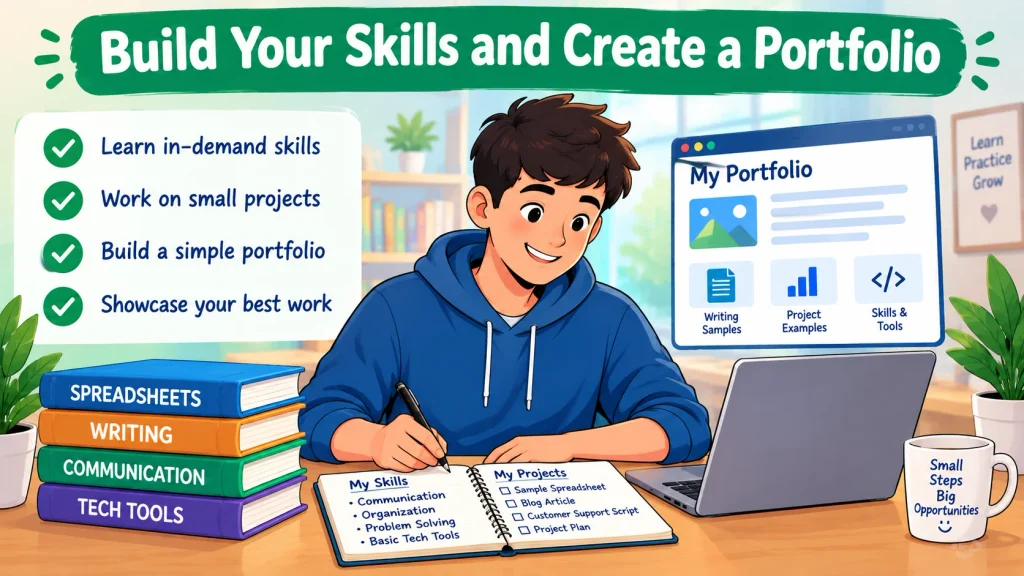
A straightforward portfolio might include:
- A short introduction
- The skills or services you offer
- Two to five relevant examples
- A brief explanation of each project
- Appropriate contact information
Keep it focused.
Five strong, relevant examples are generally more useful than twenty unrelated pieces of work.
What If You Have Never Had a Client?
Create realistic practice examples.
Someone interested in content writing could publish a sample article. A beginner interested in data-related work could build a spreadsheet and explain how the information was organized. Someone targeting customer support could write responses to realistic customer questions and demonstrate how they would handle different scenarios.
Again, be transparent.
Do not describe practice work as paid client work.
A portfolio becomes more convincing when the person reviewing it can trust the information presented.
5. Create a Résumé for Remote Work
Your résumé has one central job: make it easy for an employer to understand what you can contribute.
If your professional history is limited, resist the temptation to fill the page with irrelevant information simply to make the résumé appear longer.
Instead, emphasize evidence that relates to the position.
Depending on your background, that might include:
- Relevant skills
- Education or training
- Personal projects
- Volunteer experience
- Internships
- Freelance work
- Relevant certifications
- Achievements that demonstrate useful abilities
Example
Instead of writing:
“I have no work experience.”
You could describe an actual project:
Personal Spreadsheet Project
Created and maintained a spreadsheet to organize monthly expenses, categorize transactions, and calculate totals using basic spreadsheet formulas.
The second example gives the reader something concrete.
It demonstrates what you did, how you did it, and which skill was involved—without pretending that the project was professional employment.
6. Tailor Your Résumé to Each Job
Sending exactly the same résumé to every employer may save a few minutes per application, but it can also make your qualifications harder to understand.
Read the job description carefully.
Identify the requirements that genuinely match your experience, then make those qualifications easy to find in your résumé.
For example, if a position emphasizes:
- Customer communication
- Organization
- Email support
- Spreadsheet skills
your résumé should clearly present evidence related to those areas—provided you actually possess those skills.
Do not copy every keyword from the advertisement simply to make your résumé appear relevant.
The goal is not to manipulate an automated screening system.
The goal is clarity.
A recruiter should be able to look at your résumé and quickly understand why your actual background is relevant to the position.
7. Build a Professional Online Presence
Some remote employers may review an applicant’s professional online presence before moving forward.
That does not mean you need thousands of followers, a personal brand, or an elaborate website.
You simply need to make your professional information easy to understand.
A basic professional profile can include:
- Your name
- A professional photo, if you choose to use one
- A concise description of your skills
- Education or training
- Relevant projects
- Portfolio links
- Appropriate contact information
Think of your profile as an extension of your résumé.
A potential employer should not have to solve a mystery to figure out what you do.
8. Search for Remote Jobs in the Right Places
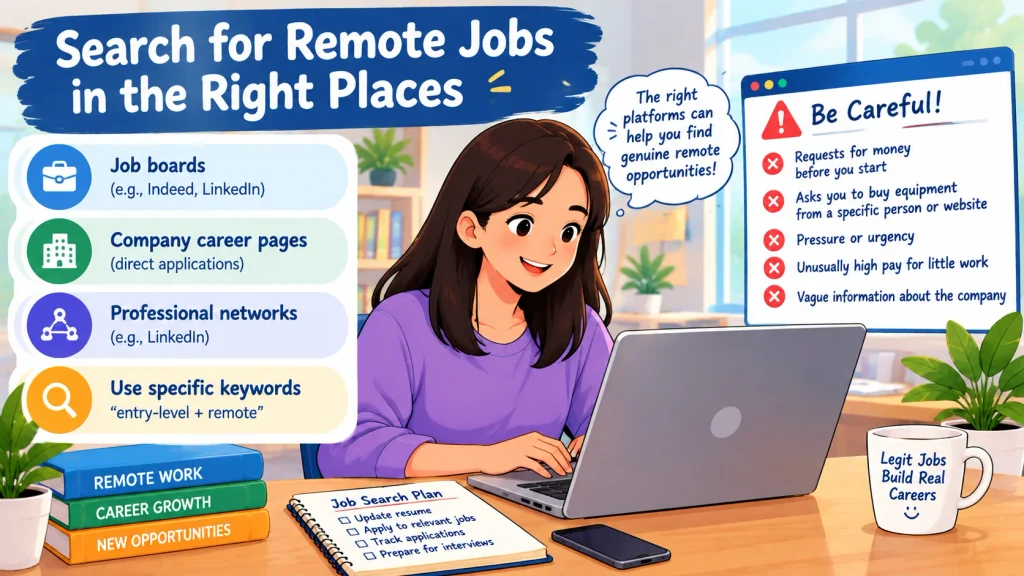
Look for opportunities through reputable job boards, company career pages, professional networks, and established employment resources.
A useful search formula is:
Role + experience level + remote
For example:
- Entry-level customer support remote
- Junior administrative assistant remote
- Remote technical support trainee
- Remote content assistant
- Junior virtual assistant
You can also go directly to the career pages of companies that employ remote workers.
This can help you verify that a position actually exists and give you access to the employer’s official application process.
Be Careful With Job Listings
A job advertisement does not automatically become legitimate simply because it appears on the internet.
Be cautious if an opportunity:
- Requests money before you can begin
- Requires you to purchase equipment from a specific person or website
- Requests sensitive financial information unusually early
- Uses pressure or urgency to prevent you from researching it
- Promises unusually high compensation for very little work
- Provides vague information about the company or role
- Sends suspicious payment or check instructions
Research the employer independently.
Whenever possible, verify important job details through the company’s official website or career page before sharing sensitive information or accepting an offer.
A little skepticism can save you considerable trouble.
9. Write Better Job Applications
A strong application does not need to be enormous.
In many cases, concise and specific is more effective than lengthy and generic.
Focus on three questions:
Why are you interested in this position?
Which relevant skills do you have?
What evidence shows that you can perform the work?
Compare these two approaches.
“I am hardworking and passionate.”
The statement is positive, but almost anyone can write it.
Now consider:
“I recently completed a project that required organizing information in a spreadsheet, checking the data for errors, and presenting the results clearly.”
The second statement provides evidence.
That is the difference.
Whenever possible, replace broad claims about your personality with specific examples of things you have actually done.
10. Prepare for Remote Interviews
A remote interview may evaluate more than your answers to conventional interview questions.
The employer may also want to understand how you communicate, organize your work, respond to uncertainty, and collaborate when you are not physically sitting beside your colleagues.
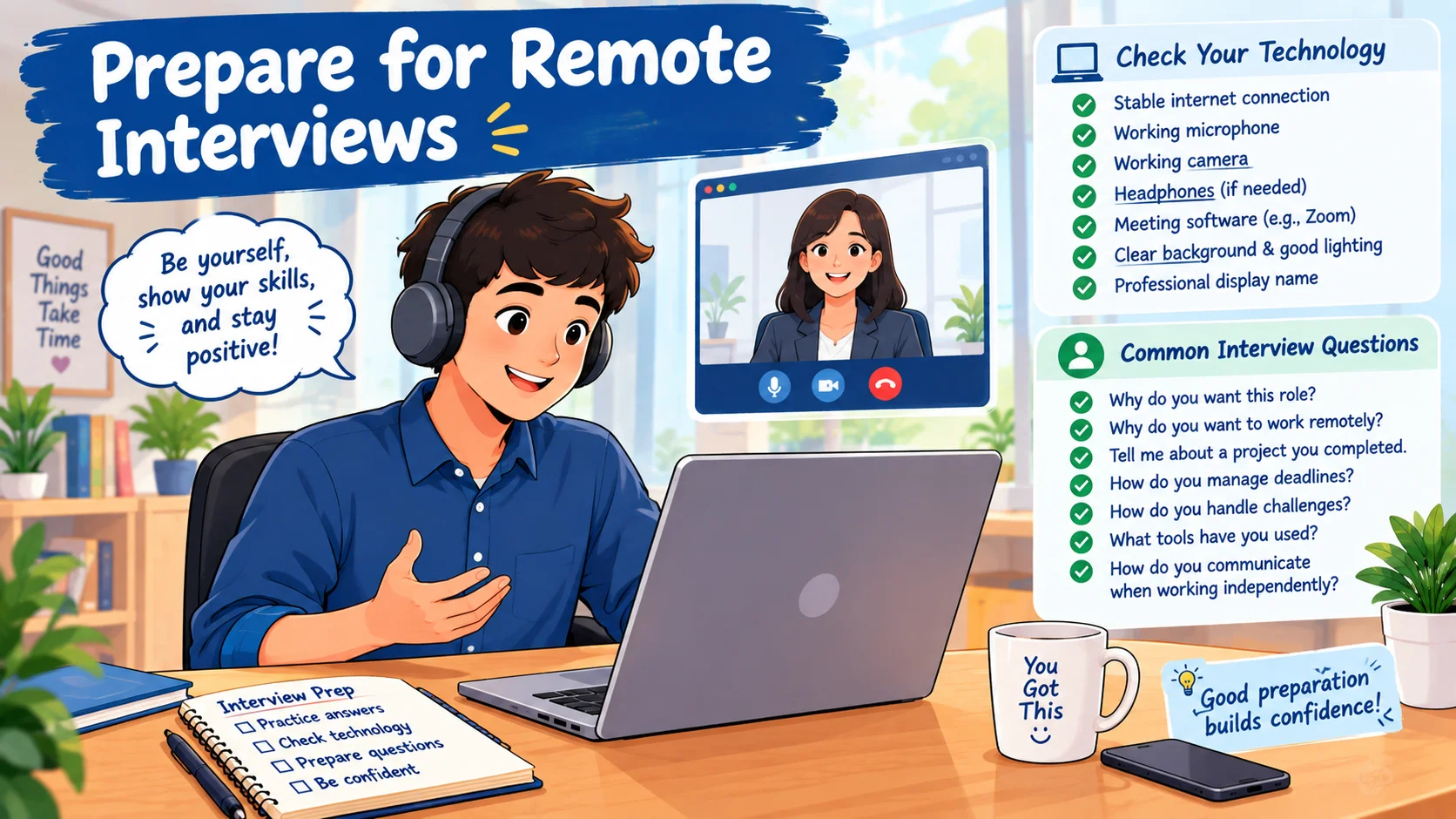
Prepare for questions such as:
- Why are you interested in this position?
- Why do you want to work remotely?
- Tell me about a project you completed.
- How do you organize competing deadlines?
- How would you handle a task you do not understand?
- What tools have you used?
- How do you communicate when working independently?
If you do not have professional examples, use genuine examples from education, volunteering, personal projects, internships, or other relevant activities.
Your example does not need to come from a corporate office to demonstrate a real skill.
Test Your Technology
Before an online interview, check your:
- Internet connection
- Microphone
- Camera
- Headphones
- Meeting software
- Display name
- Background and lighting
You do not need expensive equipment.
What matters most is that you can communicate clearly and reliably.
How to Get Experience Before Getting Your First Remote Job
There is a frustrating loop that many beginners encounter:
You need experience to get a job, but you need a job to get experience.
Fortunately, traditional employment is not the only way to create evidence of your abilities.
You can sometimes break the cycle by building experience through projects, volunteering, and legitimate freelance work.
Personal Projects
Create something connected to your target occupation.
For example:
- Build a small website if you are learning web development.
- Create sample spreadsheets for administrative work.
- Write several articles if you are pursuing writing.
- Develop mock customer-service scenarios.
- Organize a sample project using a project-management tool.
The project should demonstrate a skill rather than merely announce that you have one.
Volunteer Work
A legitimate volunteer project can provide practical experience while helping an organization.
For example, you might help organize information, manage communications, prepare documents, or assist with a digital project.
Be transparent about whether the work was paid or unpaid.
Volunteer experience is still experience; it simply should not be presented as paid employment.
Freelance Projects
Small freelance projects can introduce you to the realities of client communication, deadlines, revisions, and delivering completed work.
However, be cautious about anyone who asks you to pay simply because they promise to provide employment or guaranteed freelance income.
An opportunity should be evaluated on its actual terms—not on promises of effortless earnings.
Remote Job Skills to Prioritize in 2026
The most useful skills depend heavily on the direction you choose.
Trying to learn everything at once can leave you knowing a little about many things while lacking enough practical ability in any one area.
Choose a target.
Then build around it.
| Career Direction | Useful Beginner Skills |
|---|---|
| Customer support | Communication, problem-solving, CRM basics |
| Administrative support | Organization, email, calendars, spreadsheets |
| Writing | Research, grammar, editing, content structure |
| Design | Design software, visual communication, portfolio building |
| Technical support | Troubleshooting, operating systems, basic networking |
| Data-related work | Spreadsheets, data organization, attention to detail |
| Sales support | Communication, research, CRM basics, organization |
| Virtual assistance | Scheduling, documentation, communication, organization |
These are starting points, not universal requirements. Job descriptions can differ significantly from one employer to another, so compare your skill set with the requirements of current positions before deciding what to learn.
How Long Does It Take to Get a Remote Job?
There is no reliable universal timeline.
Anyone who promises that you will definitely land a remote job within a specific number of days should be treated cautiously. Your results can depend on a wide range of factors, including:
- Your existing skills
- The type of job you want
- Your location and work eligibility
- The number of suitable vacancies
- Your résumé and portfolio
- Interview performance
- Employer requirements
- Your application strategy
Someone applying for entry-level customer support may have a completely different experience from someone trying to enter a specialized technical profession.
Instead of obsessing over a deadline, track actions and outcomes you can actually measure.
For example:
- Number of relevant applications submitted
- Number of applications tailored to specific roles
- Skills completed
- Portfolio projects created
- Interviews received
- Feedback collected
These measurements can reveal where the problem is.
If you are submitting applications but receiving no interviews, your targeting or résumé may need attention. If interviews are happening but offers are not, interview preparation may deserve more focus.
The numbers can tell you where to adjust.
Common Mistakes to Avoid
Applying for Jobs You Clearly Do Not Qualify For
Sending hundreds of applications without considering the requirements can consume enormous amounts of time.
Instead, focus primarily on positions where you meet the core requirements or can reasonably develop the missing skills.
Using a Generic Résumé
A résumé that does not communicate relevance makes the employer do the work of figuring out why you might be suitable.
Make that connection easier.
Claiming Skills You Do Not Have
Do not list advanced software, languages, certifications, or professional experience you have never actually obtained.
If you are learning something, say that you are learning it.
Honesty is more sustainable than exaggeration.
Ignoring Job Descriptions
Read the complete listing.
Pay attention to:
- Working hours
- Location restrictions
- Required qualifications
- Compensation structure
- Time-zone expectations
- Employment type
A position can be advertised as remote while still being restricted to workers in specific countries or regions.
Paying for a Job Opportunity
Be extremely cautious when an opportunity requires payment simply to access employment.
Legitimate businesses can have legitimate expenses related to professional training, equipment, or certifications. That is different from paying someone merely for the privilege of receiving a job.
Investigate carefully before sending money.
Assuming Remote Means Flexible
Remote and flexible are not synonyms.
A remote employee may still have fixed working hours, scheduled meetings, response-time requirements, performance expectations, and specific location or time-zone restrictions.
Working from home does not necessarily mean working whenever you want.
Remote Work vs. Freelancing: What Is the Difference?
Remote employment and freelancing can look similar from the outside—you may work from a home office, communicate online, and use digital tools—but the underlying relationship is different.
| Remote Employment | Freelancing |
|---|---|
| Usually involves working for an employer | Usually involves working independently for clients |
| May include regular working hours | Schedule may vary |
| Often involves an ongoing employment relationship | Projects may be temporary or recurring |
| Compensation depends on employment terms | Payment usually depends on projects, hours, or contracts |
| Employer generally defines the role | Freelancer usually negotiates scope and terms |
Neither model is automatically suitable for every person.
If your goal is stable employment, concentrate on remote employee positions. If you prefer project-based work and are comfortable managing clients, deadlines, contracts, and your own business responsibilities, freelancing may provide another route.
The important thing is to understand the difference before choosing your search strategy.
A Simple 30-Day Remote Job Search Plan
If the process feels overwhelming, turn it into a four-week project.
Week 1: Choose a Direction
Select one or two job categories.
Then research current job descriptions and create a list of the skills employers repeatedly request.
Do not try to prepare for every possible remote career.
Choose a direction.
Week 2: Build Your Materials
Update your résumé.
Create or improve your professional profile.
If your target field benefits from a portfolio, build one or two relevant work samples.
Keep them practical. Keep them honest.
Week 3: Start Targeted Applications
Begin applying to suitable positions instead of sending the same generic application everywhere.
Track each application:
- Company
- Position
- Date applied
- Application status
- Follow-up date
- Interview information
A simple tracking system can prevent your job search from becoming a blur of browser tabs, forgotten applications, and unanswered questions.
Week 4: Review and Improve
Look at what happened.
If you are receiving interviews but not offers, spend more time preparing for interviews.
If you are receiving very few responses, examine whether you are targeting suitable positions and whether your résumé clearly demonstrates the skills those positions require.
Then continue learning while you apply.
Your job search and your skill development do not have to be separate projects.
Frequently Asked Questions
Can I Really Get a Remote Job With No Experience?
Yes, some employers hire for entry-level remote positions.
However, “no experience” does not mean every remote position is suitable for beginners. You still need to demonstrate relevant skills, reliability, communication, and the ability to perform the work.
Your challenge is therefore not to prove that you have years of experience when you do not.
It is to provide credible evidence of what you can do.
What Is the Easiest Remote Job to Get With No Experience?
There is no single easiest remote job for everyone.
Your existing skills, the requirements of employers, your location, and the number of available positions can all affect the difficulty of your search.
Customer support, administrative support, sales support, and certain assistant roles can be potential entry points, but individual job requirements vary.
Look at the actual qualifications rather than relying on a universal list of “easy” remote jobs.
Do I Need a College Degree for a Remote Job?
Not necessarily.
Requirements depend on the employer and position. Some remote jobs require a degree, while others place greater emphasis on skills, practical experience, portfolios, certifications, or demonstrated ability.
Always check the requirements of the specific position rather than assuming a degree is either always necessary or never necessary.
Can I Work Remotely From Another Country?
Sometimes.
It depends on the employer, position, employment arrangement, tax considerations, work authorization, and other legal or administrative requirements.
A job can be described as remote while still being available only to workers located in particular countries or regions.
Before accepting a position, check the employer’s official information and the applicable local requirements.
How Can I Tell Whether a Remote Job Is Legitimate?
Research the employer independently.
When possible, verify the position through the company’s official career page. Be cautious about requests for money, unusually early requests for sensitive information, vague company details, or promises of extremely high compensation for minimal work.
Also be skeptical when someone pressures you to act immediately.
A legitimate opportunity should give you enough information to investigate what you are being offered.
Conclusion
Learning how to get a remote job with no experience is not really about discovering a hidden shortcut.
It is about building credible evidence that you can do useful work.
Start with a realistic target. Identify the skills you already possess, then close the most important gaps through focused learning and practical projects. Build a résumé that emphasizes relevant evidence rather than apologizing for a limited employment history. Create work samples when they can strengthen your application. Search reputable sources, customize your applications, and prepare seriously for remote interviews.
Your first remote position may not be your dream job.
That is okay.
The first objective is to establish a foundation. A successful project can become evidence. A volunteer assignment can become experience. An entry-level position can lead to stronger responsibilities later.
The search may take time, and there is no universal timetable. What matters is that you keep learning from the process rather than repeating the same approach indefinitely.
Most importantly, remain accurate about your background.
Do not invent experience. Do not inflate skills. Do not present practice work as paid client work.
A focused résumé, relevant skills, genuine work samples, thoughtful applications, and careful research can give you a much stronger starting point for building a remote career in 2026.
Ready to boost your productivity? Explore the top-rated tools that can streamline your daily work at Freelance.AmiinMarketer.com.