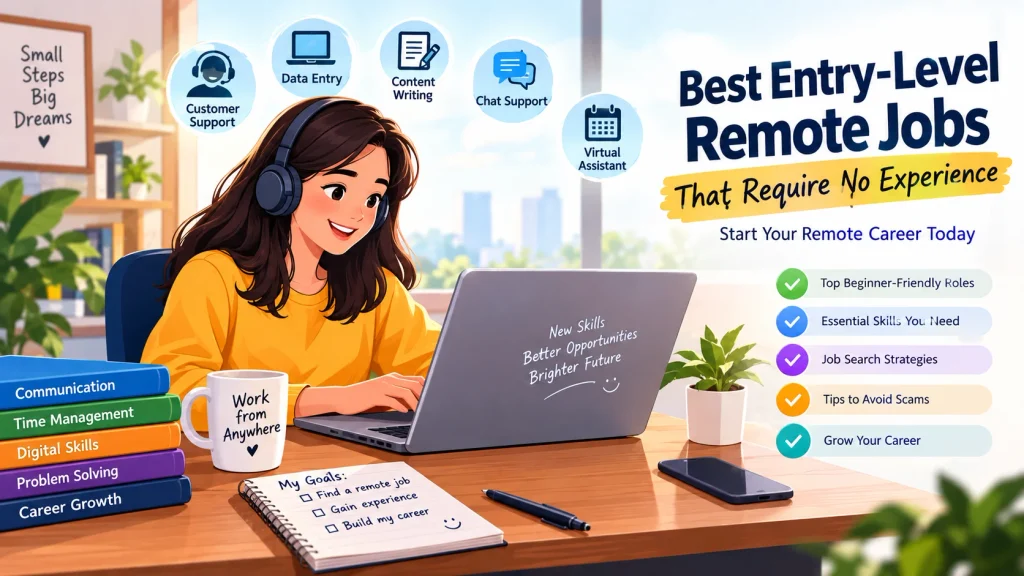
Finding legitimate Remote Jobs when you have little or no professional experience can seem like a frustrating task. Many listings appear to demand previous employment, specialized qualifications, or a résumé packed with achievements. Yet the remote job market is broader than it first appears.
There are entry-level opportunities where employers may care less about an extensive work history and more about qualities such as communication, reliability, organization, digital literacy, attention to detail, and the willingness to learn.
The trick is knowing where to look—and, just as importantly, understanding how to present the skills you already possess.
Perhaps you have organized school projects, managed social media accounts, helped customers, written articles, worked with spreadsheets, volunteered in your community, or learned software independently. Those experiences may not carry an impressive job title, but they can still demonstrate valuable, transferable abilities.
In this guide, we’ll explore 15 entry-level remote jobs for beginners, explain what each position typically involves, identify useful skills, and discuss practical ways to improve your chances of getting hired.
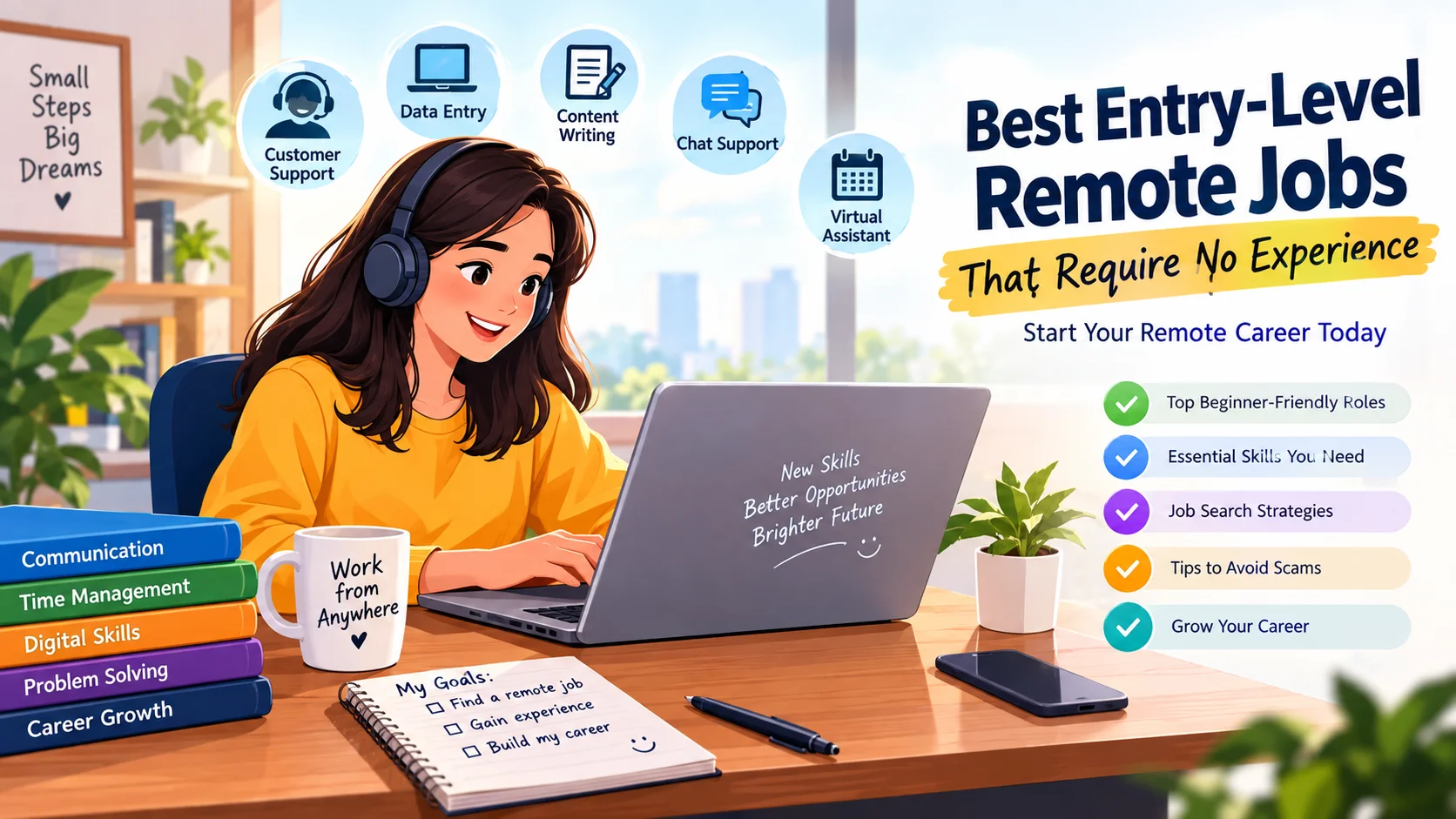
Table of Contents
What Are Entry-Level Remote Jobs?
Entry-level remote jobs are positions intended for people who are relatively new to a particular profession, industry, or type of work. Some require little previous professional experience; others may provide training once you are hired.
However, there is an important distinction worth remembering:
Entry-level does not necessarily mean qualification-free.
An employer might still expect you to have basic computer knowledge, communicate professionally, work independently, maintain a reliable internet connection, or use common digital tools.
Remote work itself also comes in several forms. A position may be completely remote, while another may be hybrid or restricted to applicants living in particular countries, regions, or time zones.
So before applying, slow down and read the job description carefully. A position that looks perfect at first glance may have location, scheduling, equipment, or eligibility requirements that don’t match your circumstances.
15 Best Remote Jobs for Beginners With No Experience
There is no single remote career that works for everyone.
Your most suitable option will depend on your existing abilities, interests, schedule, language skills, preferred communication style, and access to the technology required for the position.
The following roles are useful areas for beginners to investigate.
1. Customer Support Representative
Customer support is one of the most recognizable entry points into remote employment. Companies across many industries need people who can communicate with customers, answer routine questions, document problems, and provide clear guidance.
Depending on the employer, communication may happen through:
- Live chat
- Phone calls
- Help-desk systems
- Social media or messaging platforms
A typical day might involve answering product questions, helping a customer understand a service, recording an issue in a support system, or escalating a complicated problem to a specialized team.
The work can be repetitive at times, but it also develops highly transferable skills.
Useful skills: Clear communication, patience, problem-solving, typing, and basic computer skills.
Some employers provide training on their products, internal systems, and customer-service procedures, which can make certain positions accessible to applicants who are new to the field.
2. Virtual Assistant
Virtual assistants provide administrative support to individuals, entrepreneurs, small businesses, or larger organizations.
The exact duties can vary considerably. One employer might need help maintaining a calendar, while another could require someone to organize documents, update spreadsheets, or conduct basic online research.
Common responsibilities include:
- Managing calendars
- Organizing digital files
- Answering routine emails
- Updating spreadsheets
- Scheduling appointments
- Conducting basic online research
- Preparing documents
You don’t necessarily need years of office experience to explore this career path. In many cases, being dependable, organized, responsive, and comfortable with everyday digital tools can be extremely valuable.
Useful skills: Organization, communication, time management, Google Workspace or Microsoft Office familiarity, and attention to detail.
If you naturally enjoy keeping information organized and making sure tasks don’t fall through the cracks, virtual assistance may be worth investigating.
3. Data Entry Clerk
Data entry involves entering, updating, checking, or organizing information in digital systems.
The work might include transferring information between documents, maintaining databases, updating spreadsheets, or reviewing records for accuracy.
It sounds simple. In practice, concentration matters.
A single misplaced number or incorrectly entered detail can create problems later, especially when the information is used by another department. Because of this, employers may value accuracy just as much as typing speed.
Useful skills: Typing, attention to detail, basic spreadsheet knowledge, and careful record keeping.
One important warning: be skeptical of advertisements promising unusually large amounts of money for extremely simple data-entry work. Legitimate employers generally should not require you to pay upfront fees simply to receive a job.
4. Online Chat Support Agent
Not every customer-service position requires telephone conversations.
Some companies employ remote chat-support agents who communicate with customers entirely—or primarily—through written messaging systems. For people who feel more comfortable expressing themselves through text, this can be an appealing alternative.
Typical responsibilities may include answering frequently asked questions, troubleshooting straightforward issues, recording conversations, and forwarding complex cases to another department.
Useful skills: Written communication, typing speed, patience, and the ability to follow instructions.
Because chat support often involves handling multiple conversations or requests, staying calm and organized can be just as important as typing quickly.
5. Content Moderator
Content moderators review user-generated material according to a company’s rules, policies, or community guidelines.
Depending on the position, you might review comments, posts, images, videos, or other online submissions and determine whether they comply with established standards.
The nature of the work differs substantially between employers.
Some moderation roles may expose workers to unpleasant, offensive, or disturbing material. Anyone considering this type of work should therefore read the job description carefully and understand what the position actually involves before applying.
Useful skills: Attention to detail, sound judgment, consistency, and the ability to follow written policies.
This is generally less about personal opinion and more about applying a defined set of rules consistently.
6. Transcriptionist
Transcriptionists convert recorded speech into written text.
Assignments can include interviews, meetings, educational recordings, business conversations, or other forms of audio.
Although transcription may look straightforward, the difficulty can vary dramatically depending on audio quality, background noise, accents, speaking speed, terminology, and the accuracy standard required.
Useful skills: Strong listening ability, typing, spelling, grammar, and concentration.
If you’re considering freelance transcription, investigate the platform’s requirements and payment structure before investing significant time. Different opportunities can vary widely in workload, expectations, and compensation.
7. Online Tutor
If you have strong knowledge of a school subject, language, software application, or another teachable skill, online tutoring can provide another route into remote work.
The requirements vary substantially from one platform or employer to another. Some tutoring positions require formal teaching credentials, while others place greater emphasis on subject knowledge, communication ability, or practical expertise.
Possible tutoring areas include:
- Language learning
- Mathematics
- Science
- Writing
- Computer skills
- Academic subjects
Useful skills: Communication, patience, subject knowledge, and the ability to explain concepts clearly.
You don’t necessarily need to know everything about a subject to teach beginners. What matters is being able to understand the learner’s problem and explain the concept in a way that makes sense.
8. Social Media Assistant
Businesses and organizations increasingly depend on social platforms to communicate with customers, promote products, and maintain an online presence.
A social media assistant may help schedule posts, organize content ideas, respond to straightforward messages, prepare captions, or collect material for future campaigns.
However, don’t assume every social media position is genuinely entry-level. Some employers expect previous marketing experience, knowledge of analytics, advertising platforms, or content strategy.
Useful skills: Writing, organization, basic design, social media familiarity, and creativity.
If you’ve already managed a personal page, created content, experimented with basic design tools, or maintained a community online, you may have relevant experience worth highlighting.
9. Sales Development Representative
Some remote sales positions are specifically structured for people beginning their careers in sales.
A sales development representative, often called an SDR, may research potential customers, send outreach messages, qualify leads, and arrange conversations between prospective customers and other members of the sales team.
The role can be communication-heavy. It may also involve performance targets, quotas, or commission-based compensation.
Useful skills: Communication, confidence, organization, research, and persistence.
Before accepting an opportunity, read the compensation structure carefully. Understand the difference between guaranteed pay, bonuses, commissions, and performance-based earnings.
10. Appointment Setter
Appointment setters help businesses arrange meetings with potential or existing customers.
Depending on the organization, the job might involve making phone calls, responding to inquiries, sending messages, following up with prospects, and maintaining appointment schedules.
Some employers provide scripts and training. Others expect applicants to arrive with previous customer-service or sales experience.
Useful skills: Communication, organization, punctuality, and professional telephone or written communication.
The ability to follow up consistently matters here. A missed message or poorly organized schedule can easily result in a missed opportunity.
11. Junior Administrative Assistant
Administrative work isn’t confined to traditional offices. Many administrative tasks can now be completed digitally, making certain junior administrative positions suitable for remote work.
A junior administrative assistant may support calendars, documents, spreadsheets, email communication, scheduling, or routine organizational tasks.
Useful skills: Organization, Microsoft Office or Google Workspace, communication, and attention to detail.
For someone with limited employment history, school projects, volunteer work, community activities, or personal organizational projects can sometimes demonstrate relevant abilities.
12. Search Engine Evaluation Worker
Search engine evaluation work generally involves reviewing search results and assessing how well they correspond to particular queries or established guidelines.
The requirements and availability of these positions can vary by employer and country.
Strong language skills are often useful because the work may require careful reading, interpretation, and consistent application of detailed instructions.
Useful skills: Research, reading comprehension, attention to detail, and familiarity with internet search.
This type of work can be quite different from ordinary web browsing. Evaluators generally need to follow specific standards rather than simply deciding whether they personally like a search result.
13. Freelance Writer
Writing is another potential path into remote work, particularly if you already have strong written communication skills.
Beginners can explore several forms of writing, including:
- Blog articles
- Product descriptions
- Website content
- Newsletters
- Social media copy
- Basic business documents
The absence of professional experience doesn’t mean you cannot create a portfolio.
For example, an aspiring writer could produce several original articles on different subjects, write sample product descriptions, or create mock website copy for an imaginary business.
The samples don’t need to pretend to be client work. Their purpose is simply to demonstrate what you can do.
Useful skills: Grammar, research, organization, and clear writing.
14. Proofreading Assistant
Proofreading involves examining written material for mistakes in spelling, grammar, punctuation, formatting, and consistency.
Professional proofreading can require considerable skill, especially when working with technical, legal, academic, or specialized material. Still, beginners with strong language abilities can use smaller projects and practice samples to develop experience.
Useful skills: Grammar, concentration, attention to detail, and strong command of the language.
If you routinely notice spelling errors that other people overlook, proofreading may be worth exploring—but accuracy needs to be consistent, not occasional.
15. Technical Support Trainee
Technical support doesn’t always begin with advanced programming or years of IT experience.
Some companies offer junior or trainee positions for people who possess basic technical knowledge but haven’t yet built a professional track record.
Depending on the employer, you might help customers with account access, software settings, basic troubleshooting, or common technical questions. You’ll also need to learn the company’s products and internal support procedures.
Useful skills: Basic troubleshooting, communication, logical thinking, and willingness to learn.
A curious mindset can be especially valuable here. Technical support often requires figuring out why something isn’t working and then methodically narrowing down the possible causes.
How to Choose the Right Remote Job
Having numerous options sounds helpful. Oddly enough, it can make the search harder.
Instead of applying randomly to every remote position you encounter, begin by matching potential roles with the abilities you already possess.
Ask yourself a few straightforward questions.
Do You Prefer Written or Spoken Communication?
If writing comes naturally to you, consider areas such as chat support, data entry, content writing, proofreading, or administrative work.
If you are comfortable speaking with customers or explaining information aloud, customer support, tutoring, appointment setting, and sales may be worth exploring.
Neither style is inherently better. The important thing is finding a role that fits how you communicate most effectively.
Are You Organized?
Strong organizational skills can be particularly useful in virtual assistance, administration, scheduling, and project-support work.
If you enjoy creating lists, managing calendars, arranging information, or keeping track of multiple tasks, don’t underestimate that ability. Businesses rely heavily on people who can keep work moving without constant supervision.
Do You Enjoy Working Independently?
Remote work frequently requires a degree of independence.
There may be fewer opportunities to walk over to a colleague’s desk and ask a quick question. Instead, you’ll often need to read instructions, investigate problems, manage your schedule, and communicate digitally.
If you prefer structured routines and independent work, administrative or data-focused positions may be worth investigating.
Do You Already Have a Specialized Skill?
Don’t automatically label yourself as having “no experience.”
Professional employment is only one source of experience.
School projects, volunteer activities, freelance work, personal projects, internships, community involvement, and self-directed learning can all reveal transferable abilities.
The better question is often: What can I already do that an employer might find useful?
Skills That Can Help You Get Remote Jobs
You don’t necessarily need an impressive collection of technical qualifications to begin exploring entry-level remote employment.
Several foundational skills can make your applications considerably stronger.
Communication
Remote employees communicate through email, chat, video meetings, project-management platforms, and other digital tools.
Clear communication reduces misunderstandings. It also demonstrates that you can explain a problem, ask a useful question, and respond professionally.
Time Management
Without a traditional office environment surrounding you, managing your workload becomes your responsibility.
You may need to prioritize tasks, meet deadlines, attend scheduled meetings, and complete assignments without someone physically checking on your progress.
Digital Literacy
Basic familiarity with everyday digital tools can go a long way.
Useful areas include:
- Word processors
- Spreadsheets
- Video conferencing
- Cloud storage
- Messaging platforms
- Online collaboration tools
You don’t need to master every application. You do need to be comfortable learning new ones.
Problem-Solving
Employers value people who can approach a problem logically.
That might mean researching an answer, checking available documentation, trying a reasonable solution, or knowing when to ask for assistance rather than guessing.
Attention to Detail
Small mistakes can create disproportionately large problems.
A wrong number in a spreadsheet, an incorrect customer detail, a spelling error in published content, or a missed appointment can affect other people downstream.
Careful work matters.
Willingness to Learn
For someone beginning a career, this may be one of the most useful qualities of all.
You won’t know every system on your first day. That’s normal.
What matters is whether you can learn a new process, absorb feedback, adapt to unfamiliar software, and steadily become more capable.
How to Get Remote Jobs With No Experience
Landing your first remote position usually takes more than submitting applications and waiting.
A structured approach can make the process more manageable.
1. Identify Your Transferable Skills
Start by making a simple list of things you already know how to do.
For example:
- Writing
- Using spreadsheets
- Speaking with customers
- Organizing information
- Managing social media
- Researching online
- Using office software
- Speaking multiple languages
Once you’ve identified these skills, look for job descriptions that require them.
This turns the search from a vague hunt for “any remote job” into something much more targeted.
2. Create a Simple, Professional Resume
Your résumé doesn’t need to be complicated.
If your employment history is limited, emphasize relevant skills, education, volunteer activities, projects, internships, freelance work, and other experiences that demonstrate your ability to perform the job.
Instead of focusing on what you haven’t done, show employers what you can do.
3. Build a Small Portfolio When Appropriate
A portfolio can be particularly valuable for writing, design, social media, programming, translation, and other skill-based work.
An aspiring writer, for instance, could create several original samples covering different subjects and formats.
Just keep one principle in mind: label practice work honestly. A sample created for your portfolio should never be presented as paid client work if it wasn’t.
4. Search on Reputable Job Platforms
Use established job boards and official company career pages when searching for opportunities.
Useful search phrases include:
- “Entry-level remote”
- “Remote customer support”
- “Remote virtual assistant”
- “Remote administrative assistant”
- “Remote data entry”
- “Remote trainee”
- “Work from home entry level”
Don’t stop at the search result itself. Verify the employer, read the complete listing, and check the requirements before applying.
5. Customize Your Application
Sending exactly the same application to dozens of employers can make your search feel efficient, but it often produces weak results.
Instead, examine each job description.
Identify two or three requirements and explain how your existing skills connect to them. A short application that directly addresses the employer’s needs is usually more meaningful than a generic paragraph filled with unrelated claims.
6. Prepare for Remote Interviews
Remote interviews can take place through video calls, telephone conversations, or online assessment systems.
Before the interview, test your internet connection, microphone, camera, and any required software.
Then prepare a few examples that demonstrate reliability, communication, problem-solving, teamwork, or your ability to learn.
You don’t need a dramatic career story. A clear example from school, volunteering, freelance work, or a personal project can still show how you approach responsibility.
How to Recognize Questionable Remote Job Listings
The popularity of remote work has attracted legitimate employers—and unfortunately, misleading job advertisements as well.
A little skepticism can protect you.
Be particularly cautious when an opportunity:
- Requests payment before you can start working
- Promises unusually large earnings for very little work
- Provides a vague description without explaining the actual responsibilities
- Pressures you to make an immediate decision
- Requests sensitive personal information without a clear reason
- Sends you a check and asks you to return part of the money
- Tells you to purchase equipment or services through an unusual payment process
A legitimate employer should be able to explain the position, responsibilities, hiring process, and compensation clearly.
If something feels unclear, research the company independently. Whenever possible, use the employer’s official website or verified career page rather than relying entirely on a message, advertisement, or unfamiliar third-party contact.
Advantages and Limitations of Entry-Level Remote Work
Remote employment can offer genuine advantages, but working from home isn’t automatically easier than working in an office.
It comes with trade-offs.
Potential Advantages
- No daily commute for fully remote positions
- Access to employers outside your immediate area
- Potential flexibility depending on the position
- Opportunities to develop digital workplace skills
- The ability to work from a home environment
For someone who values flexibility or lives far from major employment centers, these benefits can be meaningful.
Potential Challenges
- Some employers require specific working hours or time zones
- Home internet and equipment may be your responsibility
- Remote employees may have fewer informal opportunities to learn from colleagues
- Some positions require extensive independent work
- Competition for remote positions can be significant
- Not every advertised “work-from-home” opportunity is legitimate
Understanding both sides helps you evaluate opportunities more realistically.
Remote work is still work. The location changes; the expectations don’t disappear.
How to Improve Your Chances Over Time
Your first remote job doesn’t need to determine the rest of your career.
Think of entry-level employment as a starting point—a place where you can accumulate practical experience, learn professional systems, and discover which parts of the work you actually enjoy.
For example, someone who begins in customer support might later develop skills in technical support, account management, customer success, or operations.
A virtual assistant could gradually build expertise in project management, bookkeeping, marketing, or executive assistance.
The important principle is to use early opportunities to develop transferable skills and verifiable experience.
One job can lead to another. One skill can unlock several different career paths.
Frequently Asked Questions About Remote Jobs
1. Can I really get remote jobs with no experience?
Yes. Some employers offer entry-level positions that don’t require previous experience in the same role.
However, “no experience” doesn’t necessarily mean “no requirements.” You may still need basic computer skills, suitable equipment, reliable communication, language ability, or other qualifications listed in the job description.
2. What is the easiest remote job to get with no experience?
There isn’t one universally easiest remote job.
Hiring requirements, competition, employer expectations, location, and the applicant’s existing skills can all affect how accessible a position is.
Customer support, administrative assistance, data-related work, and certain trainee positions are examples of areas beginners can investigate.
3. Do remote jobs require a degree?
Not always.
Requirements depend heavily on the position. Some entry-level roles focus primarily on practical skills, communication, organization, or digital literacy. Other professions require formal education, certifications, licenses, or specialized training.
Always check the specific job description rather than assuming every remote position follows the same requirements.
4. How can I find legitimate remote jobs?
Start with established job platforms and official company career pages.
Research the employer, read the complete job description, and remain cautious about opportunities that require upfront payments, make unrealistic promises, or provide little information about the actual work.
5. What skills should I learn for remote work?
Useful foundational skills include written and verbal communication, time management, digital literacy, spreadsheet and document software, online collaboration, and basic problem-solving.
The most valuable skills, however, depend on the career path you’re targeting. A future writer may prioritize research and grammar, while an aspiring technical-support worker may benefit more from troubleshooting and software knowledge.
Conclusion
Finding Remote Jobs without professional experience is possible, but it rarely happens through luck alone.
A realistic strategy begins with understanding what you can already do. Identify your transferable skills, match them with appropriate entry-level positions, create a professional résumé, and build a small portfolio when your chosen field makes one useful.
Then comes the less glamorous—but extremely important—part: research.
Verify employers. Read job descriptions carefully. Understand compensation. Check schedules and location requirements. Be cautious when an offer sounds dramatically better than the work being described.
Most importantly, don’t judge an opportunity solely by the fact that you can work from home.
Look at the responsibilities, schedule, compensation structure, qualifications, employer reputation, and opportunities for professional development. A remote job should ideally do more than provide a convenient workplace; it should help you build skills and experience that remain valuable long after your first position ends.
Your first opportunity doesn’t have to be perfect.
It simply needs to be legitimate, realistic, and capable of helping you take the next step.
Explore Remote Jobs and reviews at Freelance AmiinMarketer.com